Causal-Reliability-Aware State Estimation: Learning Admissible Representations under Partial Observability
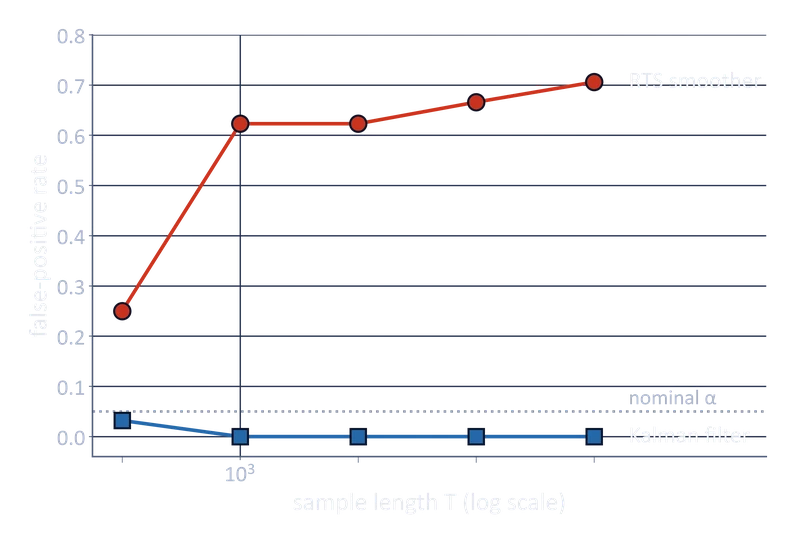
SCEM gives causal discovery its own forward-only channel, so it keeps filter-grade accuracy without giving up reconstruction.
Abstract
The constructive sequel to our filtering-vs-smoothing diagnostic: rather than asking which estimator is better, it asks which estimated-state representations are admissible for causal discovery at all. The answer rests on two independent requirements, each backed by a verified counterexample. Self-consistency: a proxy must follow its own white-residual recursion, or moving-average structure aliases into spurious autoregressive edges. Coordinate alignment: even a perfectly whitened, exogenous proxy recovers a basis-scrambled graph unless its coordinates are pinned to physical sensors — the classical rotation indeterminacy. The proposed architecture, SCEM, enforces both through a structural firewall separating a strictly forward, graph-readable causal channel from a bidirectional channel dedicated to reconstruction. In well-specified linear-Gaussian systems the causal channel provably reduces to the Kalman filter, so SCEM preserves filter-grade causal accuracy while matching smoother-grade reconstruction error — resolving the accuracy-vs-admissibility trade-off by decomposition instead of compromise. Accepted to IEEE MLSP 2026; full paper to be linked upon publication.
- Causal discovery
- Kalman filtering
- Representation learning
- Identifiability
- Partial observability
Full paper linked upon publication.